

Sensor SafyrOPC
High-precision optical particle counter.
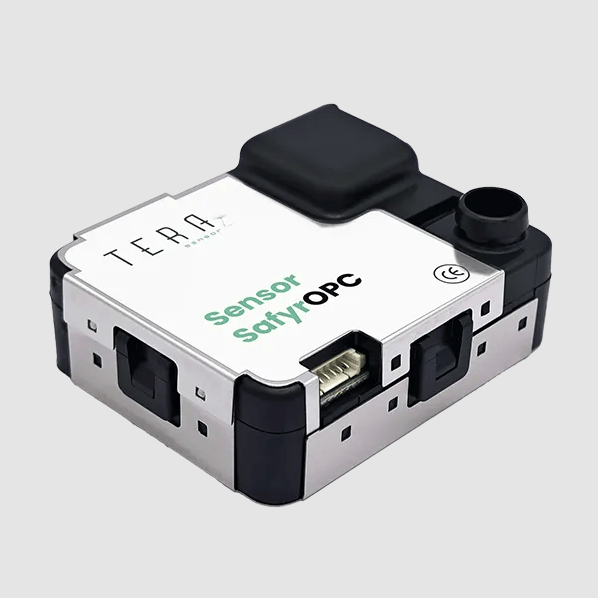
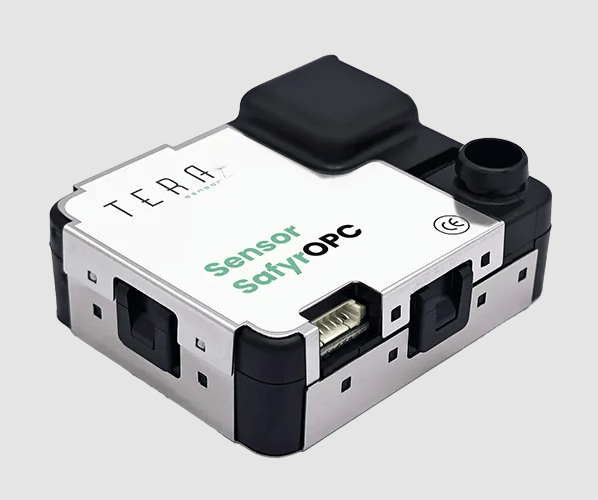
The Sensor SafyrOPC is a high-precision optical particle counter designed for cleanrooms, laboratories, and controlled environments.
Calibrated to ISO 21501-4 and supplied with an individual calibration certificate, it ensures accurate and traceable measurements of airborne particles from 0.3 to 10 µm. With a sampling flow of 2.83 L/min, resistance to H₂O₂ decontamination, and optimized design for easy cleaning, Sensor SafyrOPC delivers reliable data for GMP compliance, ISO 14644 standards, and continuous cleanroom monitoring.
Key features
- ISO 21501-4 compliant
- ISO 14644-2 ready
- Real time 5 channel in pcs/m³
- Airflow 2.83 L/mn
- Lowest detectable concentration: 350 pcs/m³
- False count: <3 pcs over 15 minutes
- Individual calibration certificate according with ISO 21501-4
Why use the Sensor SafyrOPC?
Downloads
Technical Specifications
| Technology | Optical |
| Targeted pollutants | Particulate Matter |
| Particle size detection range | 0.3—10 μm diameter |
| Concentration range |
0—3.3 10 pcs/m³ 0—9.3 10 pcs/cfm |
| Lowest detectable concentration |
350 pcs/m³ 10 pcs/cfm |
| Detection efficiency @ 0.3 μm² | 50 +/- 30% |
| Detection efficiency @ 0.5 μm² | 100 +/- 20 μg/m³ (Arizona dust A1 equivalent) |
| False count | <3 over 15 minutes raw particle number |
| Airflow | 2.83 L/min |
| Refresh rate | 1—60 seconds |
| Warm-up time | 10 seconds |
| Lifetime (MTTF) | 10,000 hours |
| Power supply | 5.0 VDC |
| Power consumption in operation | <80 mA |
| Power consumption in sleep mode | <20 mA |
| Temperature | -20—70 °C |
| Humidity | 0—95 uncondensed (%) |
| Pressure | 500—1500 hPa |
| Communication |
UART / MODBUS (RS232 & RS485) RS485 available with a converting electrical board only |
| Dimensions and weight | L 62 x W 52 x H 23 mm / 45 g |
| Certifications | CE and RoHS compliant |
Want to learn more?
Complete the form below to speak with a dedicated sensor specialist.
FAQs
ISO 21501-4 is the international standard for calibrating particle counters, and every SafyrOPC sensor is individually calibrated to this standard and supplied with its own calibration certificate. This ensures your measurements are accurate, traceable, and compliant with regulatory requirements for GMP (Good Manufacturing Practice) and ISO 14644 cleanroom standards. The calibration gives you confidence that your particle counts are reliable and defensible for quality control and regulatory purposes.
Yes. The SafyrOPC is specifically designed to resist H₂O₂ (hydrogen peroxide) decontamination, a common sterilisation method in cleanrooms and controlled environments. Additionally, its optimised design facilitates easy cleaning, ensuring the sensor can be maintained to cleanroom standards without compromising its performance or longevity (10,000 hours MTTF).
The SafyrOPC is a high-precision optical particle counter that measures particles in discrete size channels (>0.3, >0.5, >1.0, >2.5, >5.0 µm) and reports in particles per cubic meter (pcs/m³), rather than mass concentration. This level of precision is essential for cleanroom classification and compliance with ISO 14644 standards, where even low particle concentrations must be accurately counted. With a sampling flow of 2.83 L/min and detection capabilities down to 350 pcs/m³, SafyrOPC delivers the accuracy and sensitivity required for laboratories, pharmaceutical manufacturing, and other controlled environments.
The Sensor SafyrOPC delivers rapid results with a configurable refresh rate from 1 to 60 seconds and a warm-up time of just 10 seconds. This quick response enables real-time monitoring for immediate cleanroom classification verification, contamination event detection, and process control applications. The fast data output is particularly valuable during pharmaceutical manufacturing, semiconductor production, or any application where timely particle detection is critical for maintaining product quality and process integrity.
The Sensor SafyrOPC operates at a sampling flow rate of 2.83 L/min (0.1 cubic feet per minute), which is the standard flow rate specified in ISO 14644 cleanroom classification standards. This standardised flow rate ensures your particle measurements are directly comparable to regulatory requirements and industry benchmarks. Combined with its low false count rate (<3 over 15 minutes) and high detection efficiency, the Sensor SafyrOPC provides the reliable, compliant data needed for cleanroom certification, continuous monitoring, and regulatory audits.